
The progressive curriculum journey we have created builds on the experiences of students at Key Stage 1 and 2. Students will be introduced to a variety of classical fiction as well as more modern fictional texts and a wide variety of poetry and non-fiction. A key part of the English curriculum at Murray Park is to introduce students to literature which takes them on a journey through different lives and cultures. It is a love of literature and learning which has influenced our curriculum plan which gives staff the opportunity to teach texts they are passionate about, whether this is in the format of studying a whole text or a short extract. A love and passion for reading is further embedded into our curriculum through fortnightly library lessons for all year groups, offering students the chance to independently choose their own reading texts as well as engaging in activities that relate to the development of reading skills.
Building on their learning from Key Stage 2, our students will deepen their understanding of writer’s craft and technical accuracy at Key Stage 3 in order to appreciate and emulate successful writing. This will then be regularly tested through both formative and summative assessment with students responding to the feedback they are given to bridge any gaps in knowledge and continually develop their skills.
As our students enter Key Stage 4, they will begin their GCSE journey through studying a mixture of modern and classic literature in preparation for their examinations. Students will study ‘The Strange Case of Dr Jekyll and Mr Hyde’ by Robert Louis Stevenson, Shakespeare’s ‘Macbeth’, ‘An Inspector Calls’ by J.B. Priestley and an anthology of ‘Power and Conflict’ poetry. The wider world will continue to be embedded within this curriculum through the study of extracts in preparation for the English Language examinations.
Key Stage 3
In English at Murray Park, students cover a wide range of inspiring topics all designed to promote high standards of language and literacy, whilst developing in them a love of literature and an appreciation of our rich and varied literary heritage, as well as focusing their attention on the reasons why writers write and the different contexts behind the texts being examined. From creative writing to Shakespeare to poetry to grammar, students are exposed to different texts, contexts, viewpoints and writers across the five years, starting with a Key Stage 3 curriculum that has been deliberately designed to work sequentially, with each year building on the skills and knowledge acquired each year.
The national curriculum for English at Key Stage 3 aims to ensure that students:
- Develop an appreciation and love of reading, increasingly engaging with challenging material
- Understand increasingly challenging texts, from short stories to plays to poetry
- Read critically, being able to examine them in such ways as by analysing the language choices made or by comparing how different texts present ideas
- Write accurately, fluently, effectively and at length for pleasure and for information
- Plan and edit their work through considering who they are writing for and how they are using vocabulary, spelling and grammar effectively and accurately to achieve this
- Use Standard English confidently in their own writing and speech.
Our curriculum is designed with National Curriculum requirements embedded, but also with our students in mind. We aim to intrigue them and amaze them; we choose our topics very carefully so that students enjoy their learning and are also challenged. Instead of offering a ‘narrow curriculum’ that only caters to GCSEs, we strive to develop core skills in writing, reading and spoken language, promoting an increasing confidence in students with different types of text. We want students to understand the writer’s craft in both their reading and their language, relating ideas to a text’s context and understanding the influence of these factors. When studying a short story, we focus on plot, character and key themes.
When devising the English curriculum, we look to augment students’ spiritual, moral, social and cultural development: topics and texts are chosen with a view on developing these, with units titled ‘The World of Work’ and ‘News and Views,’ along with speaking and listening units for each year group offering students the opportunity to discuss thought-provoking themes and issues. In addition, we welcome visitors such as the Young Shakespeare Company and professional writers on a regular basis to build upon our work in school.
Every year seeks to build on the last; every topic seeks to develop but also recap skills learnt previously. From initially building on knowledge and skills taught at Key Stage 2, we seek to develop pupils’ linguistic knowledge, skills and understanding and offer opportunities for breadth and depth in reading and writing at Key Stage 3.
Curriculum Overview
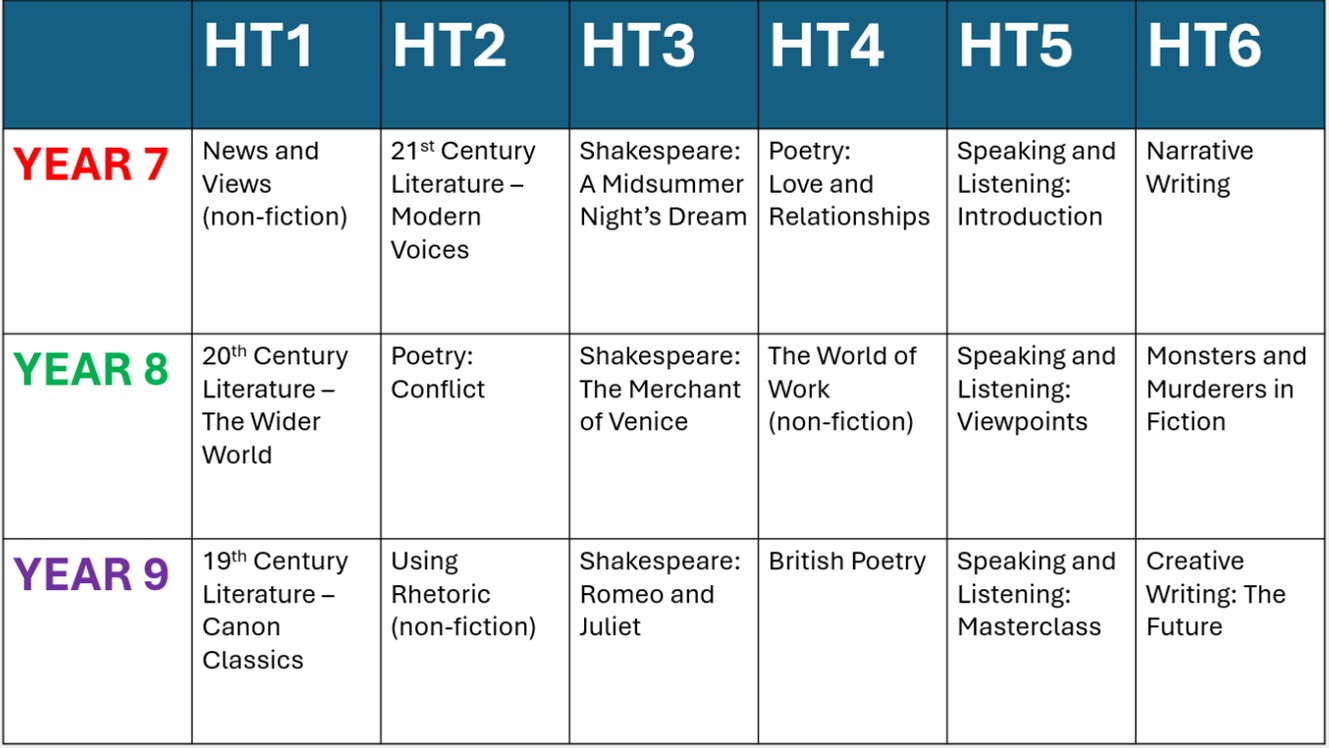
Year 7
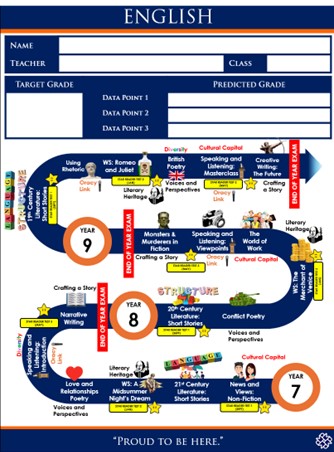
In Year 7, students examine a range of topics that mainly link to literary fiction and the linguistic devices used by writers. Students begin with our ‘News and Views’ unit which aims to encourage views about our local area in the form of non-fiction writing such as articles and news reports. Students then read a short story in our second unit, carefully selected to fully engage classes with texts from the 21st Century. As well as reading the short story critically together as a class, students specifically examine how writers use linguistic devices to shape meaning and affect their reader. They are then introduced to the works of Shakespeare with a focus on ‘A Midsummer Night’s Dream’ before looking at poetry with a thematic strand of ‘Love and Relationships’. Towards the end of the year, Year 7 prepare a speech in our ‘Speaking and Listening’ unit around the theme of ‘Identity’ in order to make them consider who exactly they are and how they see the world, appreciating the diverse nature of our society and celebrating our differences. The year is completed by examining authorial intent in the ‘Narrative Writing’ topic, where students consider how to approach story writing and building a sense of journey in a narrative.
Every fortnight, Year 7 students also visit the library to have a reading lesson: the school has invested heavily in the Accelerated Reader scheme, designed to promote reading for pleasure and help students to do so. In addition to our Sparx Reader homework programme for reading, students are provided with fantastic software to gauge their reading progress and foster a love of reading. We have also started to review and recap the learning from the whole year with our ‘End of Year Exam,’ ensuring that we assess the knowledge that students have acquired throughout the year, provide experience of exam situations in authentic settings and help students to develop key skills such as time management.
Year 8
In Year 8, students build on their prior knowledge to study a wide variety of fiction and non-fiction texts, with a more specific focus on the structural intent of the writer in addition to the linguistic analysis of Year 7. Students will start the year by enjoying a short story from the 20th Century (moving from the 21st Century in Year 7), analysing how the writer has structured the text to interest us as readers. Our short stories are chosen for their engaging plots and differing structural choices as well as their literary value. Having focused more specifically on the language of poetry in Year 7, students in Year 8 move onto analysing poetry that is centred around a theme of ‘Conflict’ and analysing the structural choices. Following this, students will study ‘The Merchant of Venice’, a play which focuses on religion and the cultural differences in society before looking at non-fiction writing in the form of our ‘World of Work’ topic, designed to expose them to a range of future possibilities by learning from the past and the present and broadening the cultural capital of our students. Towards the end of the year, students consolidate their understanding of how they write their own views and develop a persuasive argument in our ‘Speaking and Listening’ unit titled ‘Writing from a Viewpoint’. We end the year with a spotlight on the gothic genre while studying ‘Monsters and Murderers’, a scheme of learning which embeds key skills through analysing both fiction and non-fiction as preparation for a gothic story. The final ‘End of Year Exam,’ as with Year 7, concludes the year with a look back at the content of the year in addition to gauging the ability of students in technical accuracy for English.
Our Accelerated Reader scheme also continues for Year 8 students with fortnightly library reading sessions, continuing to help students to read texts suitable for their reading age for pleasure, with staff ready to listen to them read to ensure fluidity and comprehension.
Year 9
In Year 9, the department of English continue to raise the level of challenge compared to previous years. Sequentially, students take the specific focus areas of previous years and begin to look at texts in more depth by analysing language and structure simultaneously. Students start the year with studying a 19th Century story, ensuring that students are exposed to a higher level of challenge in language and starting to explore writers’ intended messages and meanings. Students then move onto the creative side of writing with the unit ‘Using Rhetoric,’ a half-term that is dedicated to writing persuasively in a variety of styles including letters, articles and speeches. In this unit, students are given the opportunity to write to anyone in the UK with a free posted letter – in recent previous years, students have received responses from the likes of David Attenborough, J.K. Rowling, David Walliams, Tottenham Hotspurs Football Club and even the Queen! Our focus then switches to examining ‘Romeo and Juliet’ by William Shakespeare – the first tragedy play that students look at in KS3 – before an emphasis on ‘British Poetry’ that takes in classic poetry by the likes of Blake, Wordsworth and Rossetti, but also exposing students to the modern world of poetry with local poets from Derby such as Jamie Thrasivoulou (a passionate fan of Derby County) and discussing the rise of poetry on social media. We then progress onto our ‘Speaking and Listening’ unit with a more advanced and nuanced study of skills in oracy, this time with a theme of national and global issues that affect students, before ending KS3 with a creative writing unit titled ‘The Future’. For this, students imagine both a utopian and dystopian future with a creative writing scheme of learning, drawing on extracts from texts such as ‘The Hunger Games,’ ‘The Handmaid’s Tale’ and ‘1984’ to inspire a final piece of writing based on dystopian worlds. The final ‘End of Year Exam,’ like with Year 7 and Year 8, concludes the year by revisiting key topics from the course of the year in addition to measuring the ability of students in technical accuracy for English.
Our Accelerated Reader scheme also continues for Year 9 students, with reading ages tracked and intervention put into place where students have reading ages significantly below expectations.
Literacy
Everything that students do in English at Key Stage 3 is designed to develop their core skills in reading, writing and speaking and listening. From their Accelerated Reader lessons that test and then seek to progress reading ages, to formative Whole Class Feedback tasks and Summative Assessments that always include marks given for technical accuracy, students are constantly asked to focus on how literate they are and how they could advance this. This is in addition to the focus we give ‘literacy errors’ when giving feedback: spellings, punctuation and grammar. We want all students to be able to communicate their ideas in the most effective ways possible.
Extra-Curricular Activities
Our English Department offers a dynamic range of extracurricular clubs and societies designed to inspire creativity, critical thinking, and a love of language beyond the classroom. Students can join the ‘Journalism Society’ for example, where they develop their reporting, interviewing, and editing skills while producing articles on school and local issues for our school magazine titled ‘Oasis’. For those who enjoy mystery and problem-solving, the ‘Detective Society’ offers thrilling opportunities to crack fictional cases and explore classic crime literature. Clubs such as these (along with many more) give students the opportunity to express themselves, collaborate with peers, and deepen their appreciation for literature and storytelling in all its forms.
To further enrich students’ learning, we regularly organise trips to theatres and venues relevant to the subject of English. In recent years, these have included performances at the Globe Theatre in London, visits to theatres across the country and local areas of interest to our ‘Journalism Society’ that offer experiences of investigative journalism. Students have also enjoyed visits to Stratford-upon-Avon and other places of cultural and literary significance, helping bring texts to life and offering real-world context for their studies.
We also believe in recognising and rewarding student achievement. As part of our commitment to motivation and celebration, students that have demonstrated an outstanding approach to learning and positive outcomes have been offered a variety of reward experiences, including exclusive workshops with visiting authors and poets such as Matt Dickinson and Bali Rai and even driving experiences and lessons!
Through our wide-ranging enrichment programme, we aim to foster a lifelong love of English and provide students with memorable experiences that extend far beyond the classroom.